Storing expensive equipment on bare dirt is a gamble that never pays off. One rainy week and your machinery is sitting in mud, rusting at the base, and sinking into ground that won’t support it through another wet season. AJ Concrete Contractor pours concrete storage pads for commercial and industrial properties across Clearwater – flat, reinforced surfaces built for heavy static loads on Pinellas County’s sandy, moisture-prone soil.
The list is longer than most people expect.
Shipping containers. Those 20 and 40-foot steel boxes weigh 5,000 to 8,500 pounds empty. Load them up and you’re looking at 40,000 to 60,000 pounds sitting on four corner castings, each one concentrating thousands of pounds on a contact area smaller than a dinner plate.
Heavy equipment. Bobcats, mini excavators, scissor lifts, generators parked between jobs. All of them leak hydraulic fluid and diesel if they sit long enough, and all of them weigh enough to punch through a thin slab.
Building materials. Lumber stacks, pipe bundles, palletized block, steel beams staged for an upcoming project. The weight distribution changes every time a delivery comes in or a load goes out.
Recreational vehicles and boats on trailers. Commercial storage yards around Clearwater rent pad space to customers who need a solid surface for their RV or boat between seasons. Tongue weight on a loaded trailer concentrates several thousand pounds on one small jack footprint.
Every one of those situations has different load characteristics. That’s why we don’t have a one-size-fits-all spec for storage pads. The design starts with what you’re storing.
Thickness depends on the load. That’s the starting point for every conversation.
Light storage – palletized goods, landscaping equipment, small trailers – typically calls for a 5-inch slab with wire mesh. It’s more than a sidewalk but less than what you’d pour for a loaded shipping container.
Medium loads – empty containers, box trucks parked overnight, mid-size equipment between jobs – move into 6-inch territory with rebar on 18-inch centers. The rebar transfers point loads across a wider area of the slab so individual spots don’t bear the full weight alone.
Heavy storage – loaded containers, large equipment, stacked materials – needs 8 inches or more. Sometimes we pour a thickened edge or a grade beam around the perimeter to prevent edge deflection. Corner castings on a loaded container push so much force into such small areas that without adequate thickness, the concrete directly underneath those points crushes. We’ve seen it. Quarter-size divots punched straight through a 4-inch slab that had no business being under a container in the first place.
Sand. That’s what most of Clearwater is sitting on. Fine, loose, sugar sand that drains fast but compacts poorly and shifts under sustained load. Great for beaches. Terrible for concrete bases.
Our storage pad prep starts by getting past the sand problem. Excavate the native soil. Bring in crushed limestone or recycled concrete aggregate as base material. Compact in lifts – meaning we don’t dump 8 inches of rock and run a compactor over it once. We put down 3 to 4 inches, compact it, test it, then add the next lift and compact again. Each layer gets verified before the next one goes on top.
Moisture barrier goes down on every storage pad. Six-mil poly sheeting overlapped and taped at the seams. Ground moisture wicking up through the slab causes efflorescence, surface scaling, and problems with anything moisture-sensitive stored on top. The barrier stops it.
In some parts of Clearwater – particularly near the Intracoastal, around Safety Harbor, and in low-lying areas south of town – the water table sits close enough to the surface that we need to raise the pad elevation with additional fill just to keep the bottom of the slab above seasonal high water. Extra material, extra compaction, extra cost. But the alternative is a slab that sits in groundwater half the year, and that’s a slab with a short lifespan.
Water pools on flat concrete. Storage pads are big, flat, and exposed to every rainstorm Clearwater throws at them. Without drainage planning, you end up with a pond where your equipment is supposed to be.
We grade every storage pad at a minimum 1% slope in one direction. On larger pads – say 40 by 60 feet or bigger – we sometimes crown the center and slope both halves toward the edges. Keeps the drainage path short so water gets off the surface quickly during heavy downpours.
Where the water goes after it leaves the pad edge matters too. If it runs toward a neighboring property, a building, or an area that can’t absorb it, you’ve got a problem. We grade the surrounding ground to channel runoff into a swale, a retention area, or a storm drain connection. Pinellas County has stormwater regulations for commercial impervious surfaces, and a large storage pad definitely qualifies.
French drains along the pad perimeter work well on sandy Clearwater soil because the water percolates down quickly once it hits the gravel trench. On tighter sites where there’s no room for perimeter drainage, we install trench drains within the slab itself – narrow channels with grate covers that collect surface water and pipe it to an outlet.
Shipping containers are probably the most common reason we get called for storage pad work in Clearwater.
A standard 20-foot container needs a pad at least 10 by 22 feet. A 40-footer needs 10 by 42. We add a couple feet on each side for access and so the corner castings aren’t sitting right at the slab edge where the concrete is weakest.
The corner castings are the whole engineering problem. Four points, each one carrying a quarter of the total loaded weight. On a full 40-foot container that can be 15,000 pounds per corner pressing down on a 7 by 7-inch contact area. That’s over 300 PSI of direct bearing pressure.
We handle this two ways depending on budget. Option one – pour the entire pad at 8 inches thick with heavy rebar throughout. Simple, effective, handles any loading pattern. Option two – pour a standard 6-inch slab but add thickened pads at the four corner locations, essentially embedded footings that go down 10 to 12 inches right where the castings land. Uses less concrete overall but requires knowing exactly where the container will sit. If you’re stacking containers in the same spot every time, option two works great and costs less.
Contractors, landscapers, rental companies, and fleet operators around Clearwater all need somewhere to park their iron between jobs. Bare ground works until it doesn’t – and in Florida’s wet season, “doesn’t” arrives fast.
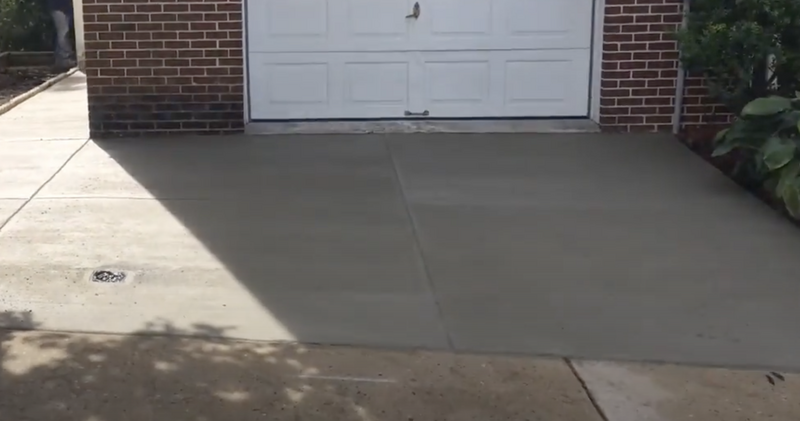
A concrete pad turns a muddy equipment yard into a functional staging area. Machines roll on and off without sinking. Fluids that drip don’t soak into the ground and create an environmental issue. And when you’re trying to load a trailer at 6 AM, you’re not fighting ruts and puddles to get to your equipment.
We’ve poured equipment yard pads for construction companies near Clearwater Industrial Park, landscaping operations off Belcher, and fleet yards along US-19 North. Each one was sized and spec’d for the specific equipment roster. A yard full of ride-on mowers needs a different slab than one storing track excavators. We get the equipment list before we design the pad.
Fluid containment is worth mentioning. If you’re storing equipment that leaks – and most older machines leak something – a sealed concrete pad keeps those fluids on the surface where they can be cleaned up instead of in the soil where they become an environmental liability. Some commercial insurance policies actually require a hard surface under stored equipment for that reason.
Pouring a big concrete slab on a commercial property isn’t always as simple as calling a contractor and scheduling the work. Clearwater has zoning rules about outdoor storage – where it’s allowed, what screening is required, how much impervious surface the lot can have.
Some zoning districts restrict outdoor storage entirely. Others allow it with conditions – privacy fencing, setback distances, maximum height of stored materials. We don’t do the zoning research for you, but we’ll tell you to check before we pour. Nothing worse than building a beautiful 50 by 80-foot storage pad and getting a code enforcement notice two months later telling you to remove the containers.
Impervious surface limits are the other regulatory piece. Every commercial lot in Clearwater has a maximum percentage of the lot that can be covered with hard surface – buildings, parking, sidewalks, and yes, storage pads. If you’re already near the limit, adding a large pad might push you over and trigger a stormwater mitigation requirement. Your civil engineer or the building department can tell you where you stand on that.
Permits for the concrete work itself are usually straightforward. We pull them when required.
Storage pads aren’t complicated. But underthinking them leads to cracked slabs, settled surfaces, and equipment sitting in water. We’ve repaired enough failed storage pads around Clearwater to know exactly which shortcuts caused which failures.
AJ Concrete Contractor designs and pours storage pads for commercial properties, contractors, fleet operators, and storage facilities across Clearwater, Largo, Dunedin, Palm Harbor, and Pinellas County. We spec the slab for the actual load, not a guess. We prep the base for Clearwater’s actual soil, not a textbook assumption. And we build in the drainage that Florida’s rain demands.
Call (727) 758-3748 to talk about your storage pad project. We’ll come out, look at the site, discuss what you’re storing and how heavy it is, and build a quote around those specifics.
Slab thickness and reinforcement matched to your actual storage weight. Container pads, equipment yards, and material staging areas all get different specs.
Compacted aggregate in lifts on top of excavated native soil. Moisture barrier on every pour. No shortcuts on what you can’t see.
Sloped surface, perimeter grading, French drains or trench drains where needed. Water moves off, not pools up.
We look at the site, check the soil, discuss your storage needs, and spec the pad before quoting. No phone estimates.
Equipment, containers, materials, vehicles – whatever you’re storing needs concrete underneath it. AJ Concrete Contractor builds commercial storage pads across Clearwater spec’d for your loads and graded for Florida’s rain. Call for a site visit and quote.